


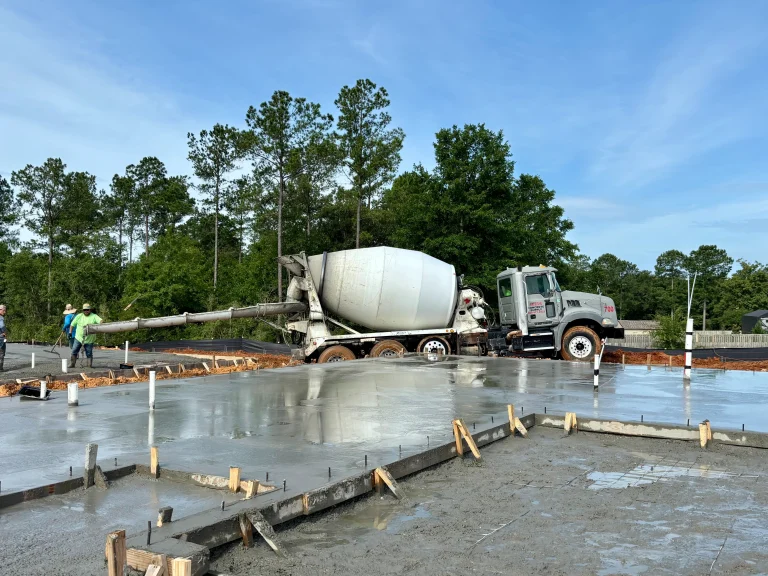

Pensacola’s heat, heavy rain, coastal salt and unpredictable weather can shorten the life of poorly planned concrete.
The problem is not solved by ordering the highest PSI available. Durability depends on the mix, exposure, site preparation, drainage, placement and curing.
The right ready-mix concrete should be selected for the actual project conditions and coordinated with all applicable plans and engineering requirements.
Planning a concrete project in Pensacola or along the Gulf Coast? Call or text American Concrete Supply at (850) 477-0222 to discuss the mix, delivery location and pour schedule.
What Is the Best Concrete for Pensacola’s Climate?
The best concrete for a Pensacola project depends on what is being built, how the concrete will be used and what environmental conditions it will face.
A residential patio several miles inland may not need the same mix as a beachfront foundation, heavily traveled commercial parking lot or industrial floor. There is no single “coastal concrete” mix that is appropriate for every job.
The project may need to address:
- Required compressive strength
- Water-to-cementitious-material ratio
- Permeability
- Coastal salt exposure
- Slab thickness
- Reinforcement
- Joint design
- Soil and base conditions
- Drainage
- Placement method
- Hot-weather conditions
- Curing requirements
Engineered projects must follow their approved plans and specifications. A concrete supplier can help produce a suitable mix, but it should not override the engineer or project documents.
How Pensacola’s Coastal Environment Affects Concrete
Pensacola and the surrounding Gulf Coast combine several conditions that can challenge concrete:
- High summer temperatures
- Strong sunlight
- Humidity
- Sudden thunderstorms
- Heavy rainfall
- Salt-laden coastal air
- Tropical weather
- Repeated wet-and-dry cycles
- Sandy or disturbed soil
- Heavy residential and commercial use
Each condition creates a different concern.
Heat can accelerate concrete setting and reduce the available placement and finishing time. Direct sunlight and wind can increase surface moisture loss. Heavy rain can damage fresh concrete. Salt exposure can contribute to reinforcement corrosion. Poorly prepared soil can settle and leave the slab without uniform support.
A durable concrete project must address the complete environment—not just the concrete’s strength rating.
What Concrete Is Best Near Pensacola Beach?
Concrete used near Pensacola Beach, Perdido Key or another exposed coastal location may require additional durability considerations.
When wind carries salt-containing moisture inland, chlorides can enter concrete through pores and cracks. If those chlorides reach conventional steel reinforcement, they can contribute to corrosion. As reinforcing steel corrodes, it expands and may cause surrounding concrete to crack or spall.
Depending on the project and level of exposure, the plans may specify:
- A maximum water-to-cementitious-material ratio
- Minimum compressive strength
- Low-permeability concrete
- Supplementary cementitious materials
- Admixtures
- Greater concrete cover over reinforcement
- Corrosion-resistant reinforcement
- Specific curing procedures
- Protective coatings or sealers
The Florida Department of Transportation evaluates corrosion-resistant reinforcement for chloride-rich coastal environments on a project-specific basis. This illustrates why coastal durability involves the full concrete and reinforcement system—not merely ordering a higher PSI. Florida Department of Transportation
Why Water-to-Cement Ratio Matters
Concrete needs water for hydration and workability, but unnecessary water can reduce its strength and durability.
The water-to-cementitious-material ratio compares the amount of water in the mix with the amount of cement and other cementitious materials. When excess water evaporates, it can leave additional capillary pathways in the hardened concrete.
Those pathways may make it easier for moisture and chlorides to penetrate the concrete.
A properly proportioned mix should provide the workability needed for placement and finishing while maintaining the required performance. Water-reducing admixtures may improve workability without the same consequences as uncontrolled water addition.
Do Not Add Water Casually at the Jobsite
When concrete begins to stiffen, workers may be tempted to add water to make it easier to place. Unauthorized or excessive water can:
- Increase the water-to-cement ratio
- Reduce compressive strength
- Increase permeability
- Increase shrinkage
- Raise the risk of cracking
- Weaken the finished surface
- Affect color and appearance
- Move the concrete outside its approved mix requirements
The National Ready Mixed Concrete Association identifies excessive jobsite water addition as a possible contributor to low concrete strength. NRMCA
Any adjustment should be coordinated with the supplier and performed within the project specifications. When additional flow is needed, an approved admixture may be more appropriate than simply adding water.
Is Higher-PSI Concrete Always Better?
No. PSI measures compressive strength, but strength is only one part of concrete performance.
Durability also depends on:
- Permeability
- Water-to-cementitious-material ratio
- Slab thickness
- Reinforcement
- Joint spacing
- Base preparation
- Drainage
- Placement
- Consolidation
- Finishing
- Curing
Higher-strength concrete may be appropriate for structural loads, heavy traffic or severe exposure. However, a higher PSI cannot correct an unstable base, insufficient slab thickness, poor drainage, misplaced reinforcement or improper curing.
For a fuller comparison, link this section to the existing article “What Is the Difference Between 3000 PSI and 4000 PSI Concrete?”
Fiber-Reinforced Concrete and Crack Control
Fiber-reinforced concrete contains synthetic or steel fibers distributed throughout the mixture. Depending on the fiber type and dosage, fibers can help control certain forms of cracking and improve performance.
Possible applications include:
- Residential driveways
- Garage slabs
- Patios
- Sidewalks
- Warehouse floors
- Commercial pavements
- High-traffic slabs
Fibers do not make concrete crack-proof. They also do not automatically replace reinforcing steel, welded-wire reinforcement, control joints or structural reinforcement.
Any substitution must be permitted by the project design and applicable specifications.
Reinforcement and Control Joints Still Matter
Concrete is strong under compression but relatively weak when subjected to tension. Reinforcement helps the concrete manage loads and movement, while control joints provide planned locations for shrinkage-related cracking.
A durable slab may require:
- Adequate thickness
- Properly supported reinforcement
- Sufficient concrete cover
- Appropriate control-joint spacing
- Timely joint installation
- Isolation from fixed structures
- A stable, compacted base
- Positive drainage
- Thorough curing
Reinforcement should remain in its designed position during placement. It should not be left on the ground with the hope that someone can pull it into the right position during the pour.
Concrete for Pensacola Driveways and Sidewalks
A Pensacola driveway must withstand vehicle loads, sunlight, rain, soil movement and regular use.
The design should consider:
- Passenger vehicles or heavier trucks
- RVs, boats and trailers
- Soil and base conditions
- Slab thickness
- Reinforcement
- Joint layout
- Driveway slope
- Drainage
- Coastal exposure
Standing water can enter cracks and joints, soften surrounding soil and contribute to settlement or deterioration. Proper grading and drainage are therefore essential parts of driveway construction.
A driveway used by passenger cars may have different requirements from one regularly carrying work trucks, delivery vehicles or a large RV.
Concrete for Pool Decks and Patios
Pool decks and patios face constant moisture, sunlight, bare feet, pool chemicals and frequent wet-and-dry conditions.
The mix and finish should be selected together. Important considerations include:
- Slip resistance
- Surface temperature
- Drainage
- Decorative appearance
- Pool-water exposure
- Saltwater pool systems
- Joint layout
- Curing and sealing
A decorative finish that becomes dangerously slippery when wet is not appropriate for a pool deck.
Workers should also avoid adding water during finishing or repeatedly working the surface. These practices can weaken the surface layer and contribute to dusting, scaling or discoloration.
Concrete for Foundations and Structural Slabs
Foundations, retaining walls and structural slabs should always comply with the approved plans.
Specifications may address:
- Compressive strength
- Water-to-cementitious-material ratio
- Footing dimensions
- Slab thickness
- Reinforcement
- Concrete cover
- Vapor barriers
- Soil-bearing capacity
- Compaction
- Placement sequence
- Testing and inspection
A different mix should not be substituted because it appears stronger or is more readily available. Any proposed change must be reviewed and approved by the appropriate design professional.
Before ordering, provide American Concrete Supply with the complete mix and testing requirements.
Concrete for Commercial and Industrial Projects
Commercial parking lots, warehouse floors and industrial slabs face more demanding service conditions than most residential concrete.
These projects may need to accommodate:
- Delivery trucks
- Garbage trucks
- Fire apparatus
- Forklifts
- Storage racks
- Heavy equipment
- Repeated turning forces
- Abrasion
- Chemical exposure
- High point loads
The mix must be coordinated with pavement thickness, reinforcement, joint design, base preparation and operational requirements.
Large placements also require detailed scheduling. The plant, dispatcher, contractor, testing agency, finishing crew and pump operator must understand the delivery sequence before the first truck arrives.
Placing Concrete in Pensacola’s Heat
Hot-weather concrete problems are not determined by air temperature alone. Concrete temperature, sunlight, wind, humidity, travel time and evaporation all affect placement.
The American Concrete Institute explains that hot weather can accelerate cement hydration and moisture loss, creating difficulties during delivery, placement, finishing and curing. ACI Guide to Hot Weather Concreting
Potential problems include:
- Faster slump loss
- Shorter working time
- Rapid setting
- Surface evaporation
- Plastic-shrinkage cracking
- Finishing difficulties
- Increased temptation to add water
- Reduced durability if curing is inadequate
Before a summer pour:
- Confirm forms and reinforcement are ready
- Provide clear truck access
- Have enough workers on site
- Arrange pumping equipment in advance
- Prepare curing materials
- Coordinate delivery intervals
- Monitor weather conditions
- Avoid unnecessary jobsite delays
Early-morning placement may reduce direct-sun and temperature exposure, but the schedule must be coordinated with the supplier and placement crew.
Protect Fresh Concrete from Sudden Rain
Pensacola thunderstorms can develop quickly. Contractors should monitor the forecast and have protective materials ready before placement begins.
Heavy rain on fresh concrete may:
- Damage the finish
- Wash cement paste from the surface
- Create uneven texture
- Cause discoloration
- Affect flatness
- Weaken the surface layer
Do not work rainwater into the concrete or spread dry cement over the surface to absorb it. The appropriate response depends on the concrete’s stage of setting and the severity of the rain.
Link this section to the existing article “What Happens if It Rains After Concrete Is Poured?” That internal link provides additional information without duplicating the entire subject here.
Proper Curing Is Essential
Concrete does not become fully durable simply because its surface feels hard.
Curing maintains suitable moisture and temperature conditions so hydration can continue. According to the American Concrete Institute, concrete develops its potential strength and durability only when it is properly cured. American Concrete Institute
Curing methods may include:
- Water curing
- Wet coverings
- Plastic sheeting
- Liquid membrane-forming curing compounds
- Other approved systems
The required method and duration depend on the mix, weather, finish and project specifications.
Pensacola’s humidity does not eliminate the need for curing. Direct sunlight, high concrete temperatures and wind can still cause damaging moisture loss.
Soil Preparation and Drainage Support the Concrete
Concrete cannot compensate for unstable soil or a base that traps water.
Pensacola-area sites may contain sand, fill, organic material, soft areas or soil disturbed during previous construction. Sand is not automatically unsuitable, but the supporting material must be appropriate, uniform and properly compacted.
Site preparation may include:
- Removing unsuitable or organic material
- Establishing the correct grade
- Installing approved fill or base material
- Compacting in appropriate lifts
- Testing compaction when required
- Correcting soft areas
- Providing positive drainage
- Preventing erosion beneath the slab
Structural and commercial projects may require a geotechnical evaluation.
Drainage should direct water away from buildings and prevent runoff from undermining slabs, driveways and sidewalks.
When an Engineer Should Determine the Mix
A licensed engineer or other authorized design professional should establish or approve the concrete requirements for:
- Structural foundations
- Elevated slabs
- Retaining walls
- Commercial buildings
- Industrial floors
- Heavy-equipment areas
- Public infrastructure
- Marine structures
- Unusual soil conditions
- Engineered plans
- Government projects
The concrete supplier can help produce a mix that satisfies the stated requirements, but the supplier should not replace the project engineer.
Ready-Mix Concrete for Pensacola and the Gulf Coast
American Concrete Supply is based in Cantonment and serves Pensacola, Milton and communities throughout the Florida and Alabama Gulf Coast.
Available ready-mix capabilities include:
- High-strength concrete
- Pump mixes
- Flowable fill
- Fiber-reinforced concrete
- Custom mix designs
- Project-specific admixtures
American Concrete Supply also provides in-house hauling, bulk construction materials and concrete washout containers. Keeping delivery and hauling within one coordinated operation helps contractors manage schedules and reduce unnecessary jobsite confusion.
Frequently Asked Questions
What concrete is best for Pensacola’s coastal climate?
The best mix depends on the project and exposure. Coastal concrete may require controlled permeability, an appropriate water-to-cementitious-material ratio, correct reinforcement and thorough curing.
What PSI concrete should I use in Pensacola?
There is no universal PSI for every project. The required strength depends on the application, loads, environmental exposure, building requirements and engineering specifications.
Does salt air damage concrete?
Salt-containing moisture can carry chlorides into porous or cracked concrete. If chlorides reach conventional reinforcing steel, they can contribute to corrosion, cracking and spalling.
Is fiber-reinforced concrete good for driveways?
Fibers can help control certain cracking, but they do not make concrete crack-proof or automatically replace structural reinforcement and properly designed joints.
Can concrete be poured during hot Florida weather?
Yes, but the supplier and placement crew should coordinate delivery, placement, finishing and curing to manage shortened working time, temperature and moisture loss.
Does American Concrete Supply deliver to Pensacola?
Yes. American Concrete Supply provides ready-mix concrete delivery in Pensacola, Cantonment, Milton and other communities across the Florida and Alabama Gulf Coast.
Discuss Your Pensacola Concrete Project
Pensacola’s climate demands more than a one-size-fits-all concrete order. The mix, site, schedule and placement plan must work together.
American Concrete Supply helps homeowners, contractors, builders and developers coordinate ready-mix concrete for residential, commercial, industrial and government projects.
Call or text American Concrete Supply at (850) 477-0222 to discuss your project, required mix, delivery location and preferred pour date.
Visit the concrete supply page or request a quote.