


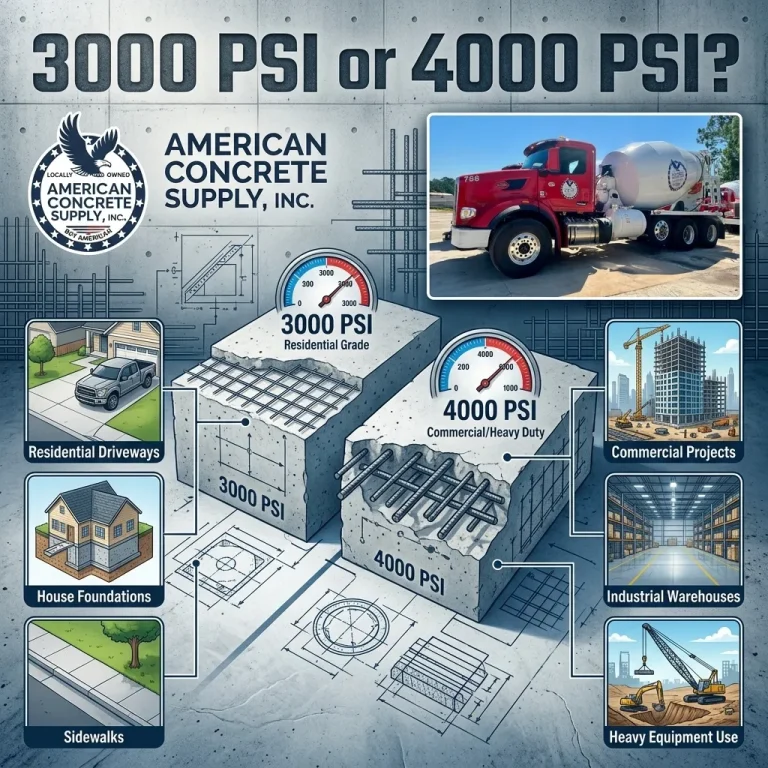

When planning a construction project, one of the most common questions homeowners, contractors, and builders ask is:
“Should I use 3000 PSI or 4000 PSI concrete?”
The right mix strength for any project is determined by local building codes and the specifications set by your contractor or engineer — it varies by project, by region, and even by individual job. This guide isn’t intended to recommend one strength over another; instead, it explains what the PSI number actually measures, so you can have a more informed conversation with your contractor, engineer, or local building department.
What Does PSI Mean?
PSI stands for Pounds per Square Inch and measures the compressive strength of concrete.
In simple terms, PSI tells you how much pressure the concrete can withstand before it begins to crack or fail.
For example:
- 3000 PSI concrete is designed to withstand 3,000 pounds of pressure per square inch.
- 4000 PSI concrete is designed to withstand 4,000 pounds of pressure per square inch.
A higher PSI rating means a stronger mix in terms of compressive strength — but strength is only one factor in how concrete performs. Cement content, water-cement ratio, reinforcement, finishing, and curing all play a role as well. The specific strength called for on any given project depends on local building codes and the engineering requirements of that project, which is why mix strength is a decision best made by your contractor, engineer, or local building department rather than a general guide.
How Is Concrete Strength Determined for a Project?
Concrete mix designs, including PSI strength, are typically specified through a combination of:
- Local building codes
- Engineering plans and specifications
- Industry standards such as ACI guidelines
- The specific demands of the project, including loads, soil conditions, and exposure
Because these requirements vary by jurisdiction and by project — even within the same type of structure — there isn’t a single strength that applies universally. A residential project, a commercial project, and an industrial project can each call for different strengths in different parts of the same job, depending on what the plans specify.
How Does Gulf Coast Weather Affect Concrete?
Florida and Alabama weather can be tough on concrete. Surfaces are exposed to:
- Intense heat
- Heavy rainfall
- Humidity
- Salt air near coastal areas
- Occasional freeze-thaw cycles during colder weather
Mix design, proper finishing, and adequate curing time all affect how well concrete holds up to these conditions over the long run — strength alone isn’t the only variable.
A Note on Curing Time
Concrete doesn’t reach its design strength the moment it’s poured — it continues to gain strength over time as it cures.
The widely used “28-day strength” is a standard testing benchmark used to evaluate concrete mix performance — it is not necessarily a “go” date for loading a structure. Curing and loading timelines vary by mix design, slab thickness, ambient temperature, and the specific demands of the project. For example, lighter-duty residential flatwork may be ready for foot or light vehicle traffic well before 28 days, while commercial and structural projects often have load-bearing requirements that extend well beyond that benchmark.
Because curing time depends on so many project-specific factors, always follow the curing guidance provided by your concrete supplier, contractor, or engineer rather than a general rule of thumb.
Does Concrete Strength Affect Cost?
Generally, yes. Higher-strength mixes typically contain more cement and cost somewhat more than lower-strength mixes. Cost is one factor among several — including code requirements, structural needs, and site conditions — that your contractor or engineer will weigh when specifying the right mix for your project.
Quick Comparison
| Feature | 3000 PSI Concrete | 4000 PSI Concrete |
| Compressive Strength Rating | 3,000 PSI | 4,000 PSI |
| Relative Strength | Lower of the two | Higher of the two |
| Relative Cost | Lower | Slightly Higher |
| Right Mix for Your Project | Determined by your contractor, engineer, or local building code | Determined by your contractor, engineer, or local building code |
Which Concrete Should You Choose?
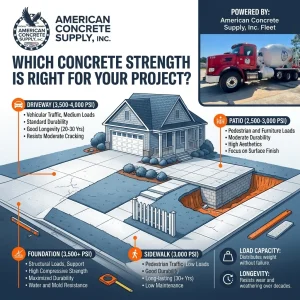
There’s no universal answer, and it isn’t a decision we make for you. The right mix strength depends on your project’s design requirements, local building codes, and the loads it needs to support — all of which are determined by your contractor, engineer, or local building department.
The best way to determine the right mix for your project is to consult your contractor, engineer, or local building code — they’ll account for factors specific to your site and application that a general guide can’t. Once you know the specification your project calls for, American Concrete Supply can deliver it.
Get Expert Help with Your Concrete Project
Have questions about your concrete order, delivery, or scheduling?
The experienced team at American Concrete Supply is ready to help with the logistics of your project — ordering, delivery timing, and scheduling. For questions about which mix strength your project requires, your contractor, engineer, or local building department is the best resource.
Contact American Concrete Supply today to discuss your project and schedule concrete delivery anywhere along the Gulf Coast.
Frequently Asked Questions
Is 4000 PSI concrete stronger than 3000 PSI?
Yes, in terms of compressive strength rating. 4000 PSI concrete is designed to withstand approximately 33% more compressive force than 3000 PSI concrete.
Who decides what PSI strength my project needs?
Mix strength is specified by your contractor, engineer, or local building code based on the requirements of your specific project. American Concrete Supply delivers ready-mix concrete to whatever specification your project calls for.
Does higher PSI always mean better-performing concrete?
Not necessarily. Strength rating is one factor in concrete’s performance, but proper mix design, finishing, and curing also play a major role. A correctly specified and properly placed and cured mix performs well for its intended use, whatever that strength happens to be.
How long does concrete take to cure?
Concrete continues to gain strength well beyond the initial pour, and curing timelines vary by mix, project type, and conditions. The standard 28-day benchmark used in the industry refers to a testing standard, not a fixed timeline for loading every project. Ask your supplier, contractor, or engineer for guidance specific to your application.
Who supplies ready-mix concrete in Florida and Alabama?
American Concrete Supply provides quality ready-mix concrete, materials, and delivery services throughout the Gulf Coast region.